
NAACP: “On August 28, 1963, more than a quarter million people participated in the historic March on Washington for Jobs and Freedom, gathering near the Lincoln Memorial.”
“More than 3,000 members of the press covered this historic march, where Rev. Dr. Martin Luther King, Jr. delivered the exalted “I Have a Dream” speech.”
https://naacp.org/find-resources/history-explained/1963-march-washington

Dr. Martin Luther King, Jr., (center), Rev. Jesse Jackson (left) and Ralph Abernathy (right) return to the Lorraine Motel in Memphis to strategize for the second Sanitation Worker’s march led by King in this April 3, 1968 file photo. King was shot dead on the balcony April 4, 1968. AP
https://citizennewspapergroup.com/news/2016/apr/07/losing-king/

African Americans won the right to vote because we and our allies marched for it, demonstrated for it, were beaten and died to gain it. After Selma, people of conscience demanded that the country live up to its Constitution and its democratic ideals.
By Jesse Jackson Mar 7, 2022, 7:00pm CDT

Anniversary of Selma march reminds us how democracy is defended.

Selma, AL
“Image above (from left): Ralph Abernathy, James Forman, Martin Luther King Jr., Jesse Douglas, and John Lewis. King leads the five-day, 54-mile march for voting rights in 1965, from Selma, Alabama, to Montgomery. Lewis was 25 years old at the time.”
https://www.theatlantic.com/magazine/archive/2018/02/john-lewis-martin-luther-king-jr/552581/
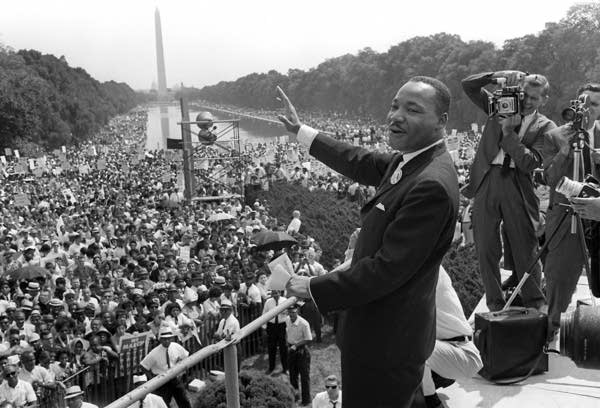
3,000 Press members cover the March on Washington.
Student Nonviolent Coordinating Committee (SNCC)
“There were a series of nonviolent protests in February to July 1960, primarily in the Woolworth store—now the International Civil Rights Center and Museum—in Greensboro, North Carolina,[1] which led to the F. W. Woolworth Company department store chain removing its policy of racial segregation in the Southern United States.[2] While not the first sit-in of the civil rights movement, the Greensboro sit-ins were an instrumental action, and also the best-known sit-ins of the civil rights movement. They are considered a catalyst to the subsequent sit-in movement, in which 70,000 people participated.[3][4] This sit-in was a contributing factor in the formation of the Student Nonviolent Coordinating Committee (SNCC).[5][6]”

SNCC
Emancipation Proclamation
“The legal institution of human chattel slavery, comprising the enslavement primarily of Africans and African Americans, was prevalent in the United States of America from its founding in 1776 until 1865, predominantly in the South. Slavery was established throughout European colonization in the Americas.”
 Media News Global Voices